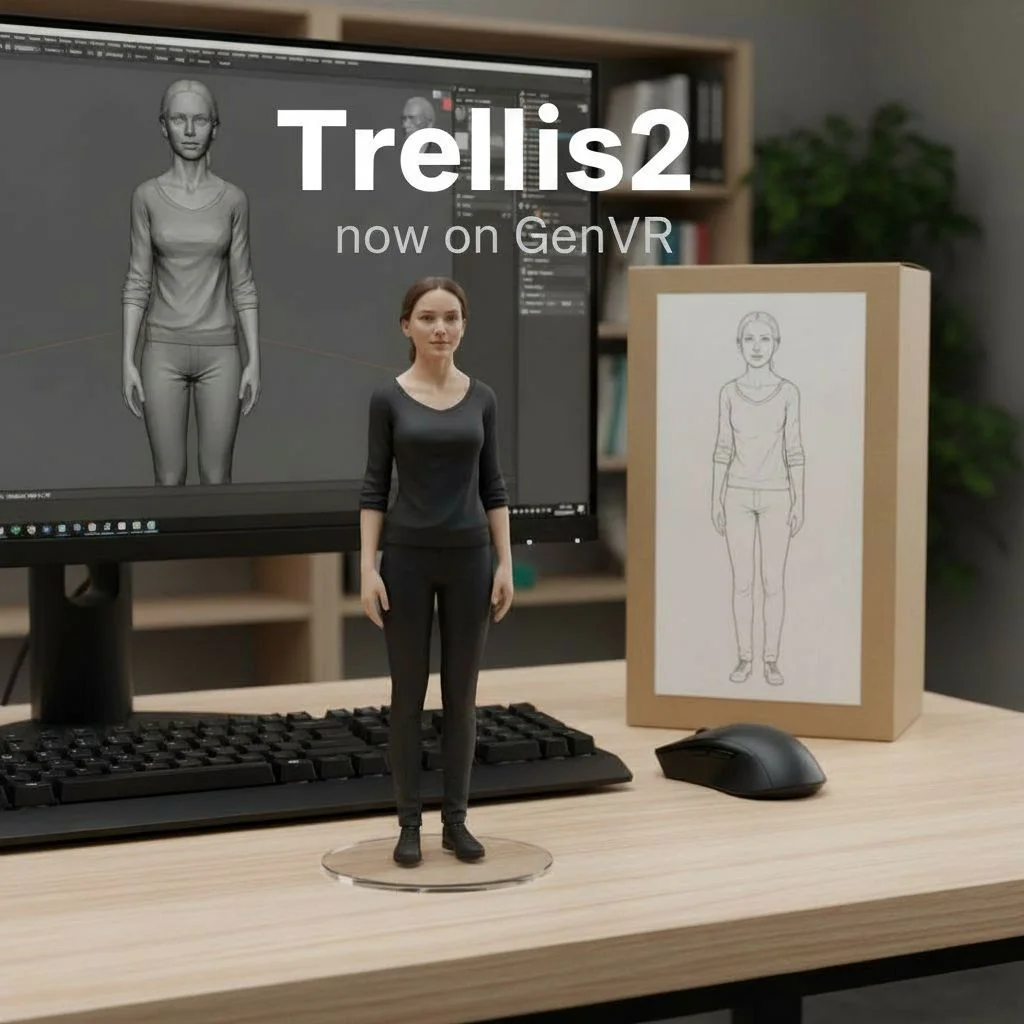
Trellis 2
Microsoft Trellis 2 is an advanced image-to-3D generation model that transforms single 2D images into high-quality textured 3D meshes and Gaussian splats using structured latent representations. Leveraging state-of-the-art diffusion techniques, it delivers production-ready 3D assets with detailed geometry and physically-based rendering textures suitable for gaming, AR/VR, and content creation workflows.
Overview
Trellis 2 is a 3d generation model available on the GenVR platform. Microsoft Trellis 2 is an advanced image-to-3D generation model that transforms single 2D images into high-quality textured 3D meshes and Gaussian splats using structured latent representations. Leveraging state-of-the-art diffusion techniques, it delivers production-ready 3D assets with detailed geometry and physically-based rendering textures suitable for gaming, AR/VR, and content creation workflows.
Key Features
- Single image to detailed 3D mesh reconstruction with manifold geometry
- Structured latent 3D representation for improved consistency and control
- PBR texture generation including albedo, normal, and roughness maps
- Dual output support for both polygonal meshes and 3D Gaussian splatting
- Multi-view consistent geometry without floating artifacts or holes
- Optimized inference pipeline for efficient GPU utilization
- Zero-shot generalization across diverse object categories and styles
Popular Use Cases
- Rapid prototyping of game assets from concept art for pre-visualization and blockout phases
- Automated generation of 3D product models for e-commerce configurators and virtual try-on experiences
- Architectural concept visualization converting reference photos into manipulable 3D furniture and fixture models
- Creation of digital collectible and NFT assets from 2D artwork for metaverse and virtual world integration
- Educational content development generating interactive 3D models from textbook images and historical photographs
Best For
- Game development asset creation and rapid prototyping pipelines
- AR/VR content development and spatial computing applications
- E-commerce product visualization and virtual showroom creation
- Architectural visualization and interior design concept modeling
- Independent 3D artists and digital content creators
Limitations to Keep in Mind
- Single object focus: Performs optimally on isolated objects rather than complex multi-object scenes or environmental compositions
- Occlusion hallucination: May generate inconsistent details for heavily occluded regions not visible in the source input image
- Animation topology: Generated mesh topology often requires manual retopology for optimal rigging and animation deformation
- Texture resolution constraints: Maximum output texture resolution may be insufficient for extreme close-up cinematic or high-end visualization requirements
- Hardware requirements: Requires discrete GPU with substantial VRAM (typically 8GB+) for practical inference speeds and quality settings
Why Choose This Model
- Exceptional Geometry Quality: Produces clean, manifold meshes suitable for professional 3D workflows without extensive manual cleanup or remeshing.
- Photorealistic Texturing: Generates detailed PBR texture maps that enable realistic rendering under various lighting conditions in standard game engines.
- Structured Latent Architecture: Utilizes organized latent representations that provide better semantic control and consistency compared to unstructured volumetric approaches.
- Flexible Output Formats: Supports both traditional polygonal meshes for animation and modern Gaussian splatting for real-time radiance field rendering.
- Strong Zero-Shot Generalization: Handles diverse object categories from furniture to characters without category-specific training or fine-tuning requirements.
- Production-Ready Assets: Generates game-engine compatible models with proper UV unwrapping that require minimal post-processing before deployment.
- Open Source Accessibility: Full model weights and architecture availability enables enterprise customization, self-hosting, and pipeline integration without vendor lock-in.
- Inference Efficiency: Optimized architecture delivers high-quality 3D generation faster than many competing solutions while maintaining competitive fidelity.
- Multi-View Coherence: Ensures geometric and textural consistency across all viewing angles, eliminating common artifacts like floating elements or texture stretching.
- API-First Design: Structured for seamless integration into existing content pipelines, asset management systems, and automated batch processing workflows.
- Hardware Optimization: Runs effectively on consumer-grade GPUs with adequate VRAM, democratizing access to high-quality 3D generation capabilities.
- Fine Detail Preservation: Captures intricate surface details, engravings, and complex topology that other image-to-3D methods often smooth over or miss.
Alternatives on GenVR
- Tripo H3.1 Multiview
- Trellis
- Hunyuan 3.1 - 3D Part
Properties
Customizable parameters available for this model.
Required
URL of the input image to convert to 3D
Optional
Random seed for reproducibility
Output resolution; higher is slower but more detailed
Texture resolution
Run remeshing (slower; often improves topology)
GenVR Visual App
Experience the power of Trellis 2 through our intuitive visual interface. Experiment with prompts, adjust parameters in real-time, and download your results instantly.
Try in Web AppDeveloper API Docs
Integrate this model into your own applications. Access enterprise-grade performance, scalable infrastructure, and detailed documentation for rapid deployment.
Try in APIMore in 3D Generation
Discover other high-performance models in the same category as Trellis 2.